

SEO is one of those industries that, as the years pass, is becoming stupidly complex—even for marketers.
So much so that some marketers won’t even touch SEO with a ten-foot pole; I used to be one of them many seasons ago.
This complexity makes SEO the perfect playground for the uninitiated to be taken on a ride.
And if you caught a glimpse of my last article, you know that SEO doesn’t work unless your business has SEO Market Fit—the sweet spot where your product-market fit aligns with search demand. If that’s missing, SEO can become a very expensive guessing game.
What if you’re pioneering a niche, inventing a new category, or your audience simply doesn’t know how to articulate their problem in a way your marketing team thinks?
That’s where most businesses crash and burn. The beginning of losing hope or outright hating SEO.
But hold on. If done right, you can engineer SEO market fit, but you’ve probably never considered it like this before.
Why Aren’t People Searching For Your Offer?
A business that doesn’t have a product-market fit also doesn’t have an SEO-market fit.
But if you have achieved product market fit and yet struggle to find visibility for your offer on search, it’s because of one or more of these issues:
A. They are not searching for a solution yet.
You’ve validated product-market fit through referrals, outbound sales, or partnerships, but when you turn to SEO, you hit a wall—nobody is searching for your solution.
This might look like a search demand problem. But often, most of your ideal audience is searching for a different problem than what you are solving or is too early on in the user journey.
Why does this happen? You (or your team) jumped right into solving the problem. What you need to do instead is identify problems (not the same thing).
But if you identify their problems correctly, you’ll soon realize you need to map your visitors’ search journey.
Hooray! Because that leads to the real problem, positioning.
Your audience isn’t clueless. They just don’t care about your solution—yet. They are not even at the stage of their customer journey you want them to be. tch tch
B. They use a different language than you.
They feel the pain, but they don’t have the language to describe it yet.
Example: You’re saying “enterprise-grade process automation,” but they’re searching for “how to reduce admin work.”
This is a messaging problem that arises from the lack of both a solid positioning and an Ideal Visitor Profile you are trying to captivate and capture through SEO.
Remember, nobody wants a drill; they need a hole in their wall. Meet your ideal visitors where they are.
C. They don’t know your solution exists and is an option.
They have the problem but don’t realize your way of solving it is an option.
Example: If you sell AI-powered sleep coaching for dogs, no one is searching for that. But they are searching for “Why does my dog wake up at night?”
And this, my pal, is a lack of search visibility.
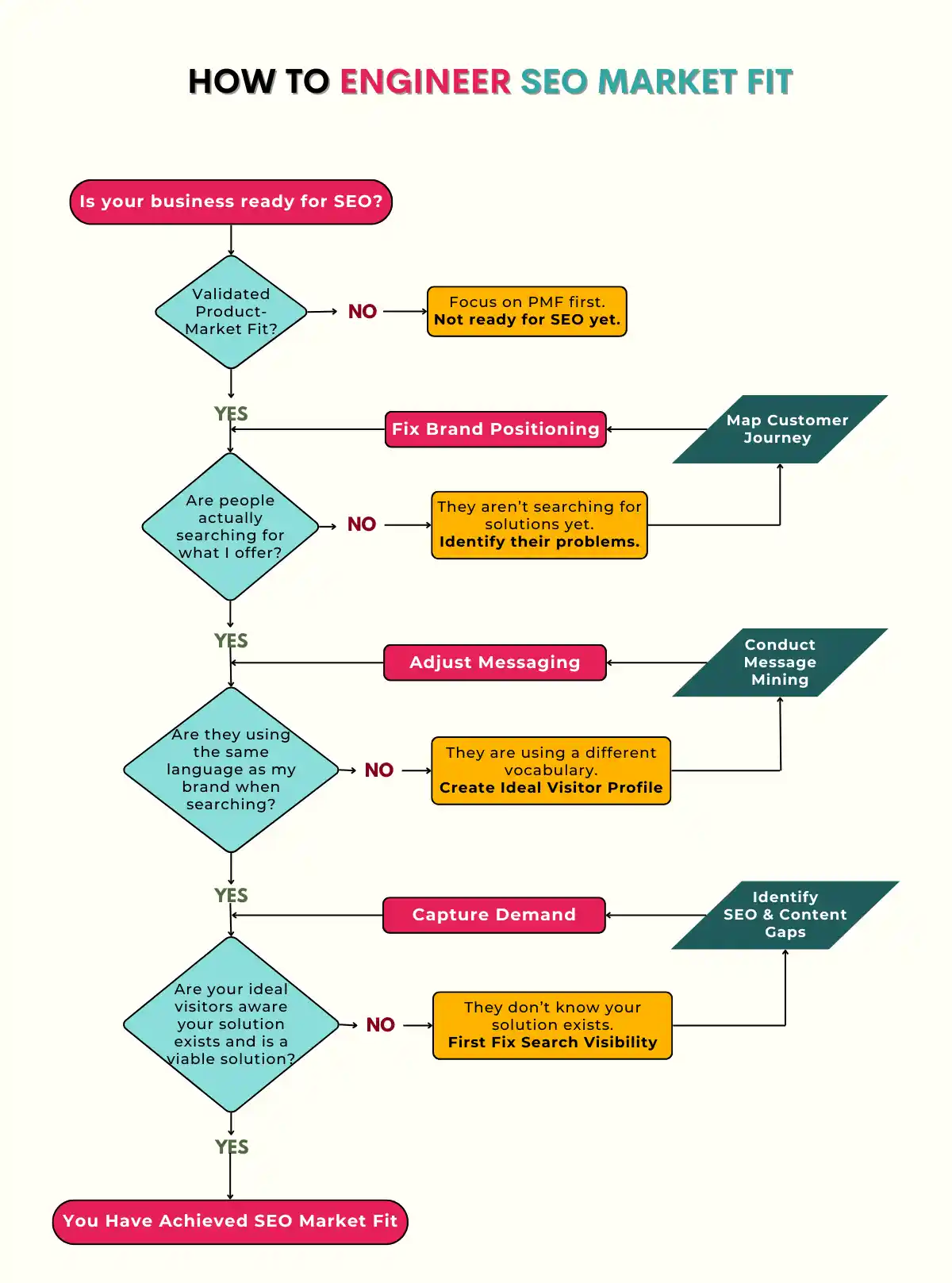
How to Engineer SEO Market Fit
If no one is searching for your offer, it’s not necessarily because demand doesn’t exist—it most likely is because your positioning and messaging are off the mark by a few yards. Fix that, and you’ll smell that sweet vein of gold called SEO-Market-Fit.
Then begins the journey of a long and profitable SEO growth curve.
Problem, Problem Everywhere, Not a Drop to Monetize
Before proceeding with this section, I need to ask you something personal.
Are you in the habit of driving business and marketing decisions based on ego and an inflated sense of self?
Then, before we move on, I suggest a 10-minute meditation session.
If the last sentence pissed you off, I suggest therapy.
Instead, if you make decisions based on market feedback and data, you’ll realize Google doesn’t reward your industry jargon.
It rewards what people actually search for. You might think (or fantasize) that you’re selling one thing or would like to position it another way, but your audience is searching for something else altogether.
If your positioning and messaging are off, you’re invisible—no matter how much SEO you do.
This is where, instead of jumping right into problem-solving, you identify problems.
Initially, it might sound a little blasphemous, but it’s exactly how doctors diagnose. In our line of work, we have become too comfortable pushing solutions without even considering the problems.
Instead of ranking for what you think is important, consider what your customer is trying to accomplish.
People don’t search for features. They search for solutions to jobs they need to have done. Your job is to bridge that gap.
Most seasoned SEOs and marketers assume people buy their product because of its features, pricing, or industry credentials (I know, right!). Believing if they explain their product well enough, their audience will “get it.”
But that’s not how buying decisions work. Does it?
According to the Jobs-To-Be-Done (JTBD) theory, people don’t buy products—they hire solutions to accomplish a task in their lives or businesses.
For example:
- Nobody wants a drill; they need a hole in their wall.
- Nobody wants productivity software; they need to stop wasting time on back-and-forth emails.
- Nobody wants AI-powered dog sleep coaching; they just want their dog to stop waking them up at 3 AM.
Your SEO strategy needs to be based on the job your audience is trying to accomplish, not what you’re selling.
Why Positioning is the Root of SEO Market Fit
If your audience isn’t searching for what you offer, it’s not because Google is broken. It’s likely because your positioning doesn’t match how people naturally think about their problem.
Most businesses optimize how they describe their offer, not how their customers think about their problem.
That used to work back in 2010.
If your SEO strategy is built around the wrong job to be done, you’ll attract the wrong audience (or no audience at all).
So you need to:
✅ Identify the Core Job-to-Be-Done.
✅ Align Your Positioning with Search Behavior.
✅ Optimize for the Job, Not the Product.
SEO won’t be a struggle if your positioning is built around your audience’s natural search behavior—it will be inevitable.
This is what engineering SEO Market Fit actually looks like. It’s not about gaming the algorithm. It’s about bridging the gap between what people need and how your brand is positioned.
So before you obsess over rankings, ask yourself: Are you optimizing for what people actually need, or just what you wish they were searching for?