
You have it all in place. A team to handle everyday SEO tasks, a solid plan to boost your ranking and traffic, and an on-page report that looks promising.
Heck, you even churn out content at a volume that makes Wikipedia blush.
Yet, somehow…it’s not working.
So you check your analytics again, tweak some CTAs, and maybe even throw in another blog post stuffed with transactional keywords—still, it’s just chirp chirp.

At this point, conversions are starting to feel like a cruel joke played by Google’s algorithmic gods.
You are not alone. Most small and medium businesses build their SEO funnels like a one-night stand: no depth, no long-term value, purely transactional.
They obsess over getting attention (top-funnel content) and closing deals (bottom-funnel pages) but completely ignore the middle of the funnel. The bridge that turns casual lurkers into paying customers.
That is, if you’re not actively guiding readers to decide, you’re just renting their attention. Uhuh! Bad for business.
Your Website’s Biggest Revenue Driver Isn’t a Blog or a Landing Page.
Most SEO strategies follow a simple formula:
- Find high-volume keywords.
- Write blog posts targeting those keywords.
- Wait for traffic to convert into leads.
But there’s a fundamental flaw with this approach. Let me be the first if no one’s told you this before.
In 2025, RANKING ≠ REVENUE.
Sure, you might capture a few people actively searching for a solution (the ones your competition is also after). But what about the others who are still figuring out their problem, weighing options, or don’t even know they need you yet?
Most businesses think their SEO funnel looks like this:
Blog → Product Page → Book a Call→ Purchase
The reality is more like:
Random Google Search → Skim Blog → Check Reddit or Quora → Forget About You → Find Your Competitors → Goes Back to Google Search → Reads Case Study → Buy From Someone Else Later
See the blind spot? No structured journey. Buyers will get busy forming trust with your competitors if you are chasing search volume (aka one-night stands) like it’s the only metric that matters or hyper-fixates on transactional keywords.
The Hidden Revenue Drivers of Your Website
If you want to turn search traffic into revenue, you must prioritize the middle-of-funnel (MOFU) assets that guide buyers toward a decision.
Here’s what actually moves the needle:
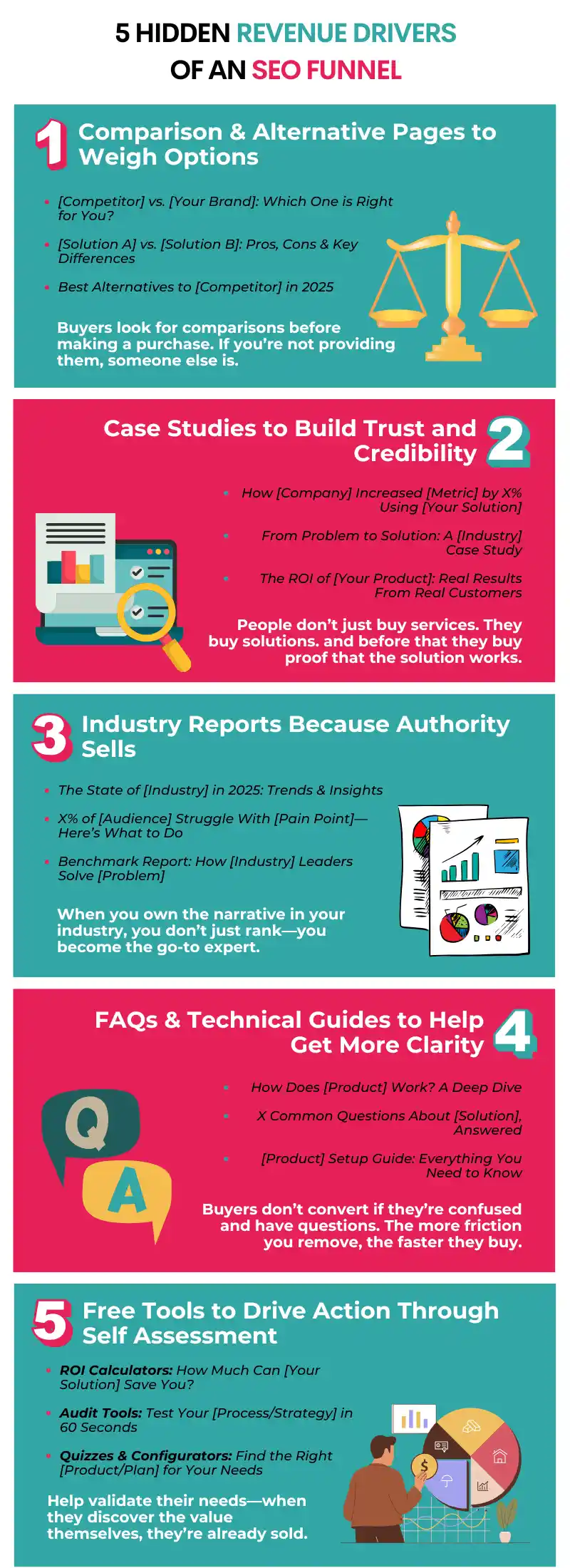
When you optimize for the middle, you don’t just capture demand—you create it.
Turning Your Content Pieces to a Revenue Pathway
Build a structured content ecosystem that nurtures buyers from awareness to action. No more short, messy one-night stands.
Here’s what you can go and do right away:
- Audit Content Gaps: Check analytics and identify where buyers drop off. Do they engage with TOFU content but never reach BOFU pages? That’s a MOFU problem.
- Topic Clustering: Organize content into interconnected themes that cover a buyer’s full journey. Instead of isolated blog posts, structure your content in hubs—where TOFU content links naturally to MOFU and BOFU assets.
- Build Content Pathways: Don’t just create one-off blog posts—design an intentional journey that moves buyers from awareness → consideration → conversion.
- Strategic Internal Linking: Every page should have a next step. Use internal links to guide searchers from problem-aware content (e.g., educational blogs) to solution-aware pages (e.g., case studies, product comparisons, and demo offers).
- Conversion-Focused Content Mapping: Align content types with intent. Blog posts create awareness, comparison pages help with evaluation, and case studies build confidence—each piece should serve a distinct purpose in the journey.
- Leverage SEO as Demand Generation: Rank not just for what people buy today but for what they will buy six months from now.
Traffic without conversion is just a vanity metric. When every piece of content has a strategic role, SEO stops being a traffic game and starts becoming a revenue engine.
Because your highest-value content isn’t always another blog post—it’s the content that bridges the gap between search and sales.
So, the real question is not whether your SEO is working—it’s whether it’s working for revenue.
📩DM me SEO Funnel if you’d like me to assess your SEO efforts.