

Textbook SEO peddlers advise that we focus efforts on ranking for high-intent keywords, those that signal a user is ready to buy.
And it makes sense, right? If someone searches for “best CRM software for small businesses,” they’re likely evaluating options and are closer to purchasing.
But here’s the problem:
- Only 3-4% of your market is ready to buy anytime.
- The remaining 96–97% is still in the awareness and research stages.
- If you ignore them, your pipeline dries up, and your long-term growth suffers.
This is where Narrative-Driven SEO comes in—an approach that creates demand by educating and nurturing problem-aware and information-seeking audiences before they’re ready to buy.
Your Best Customers Aren’t Even Searching for You Yet
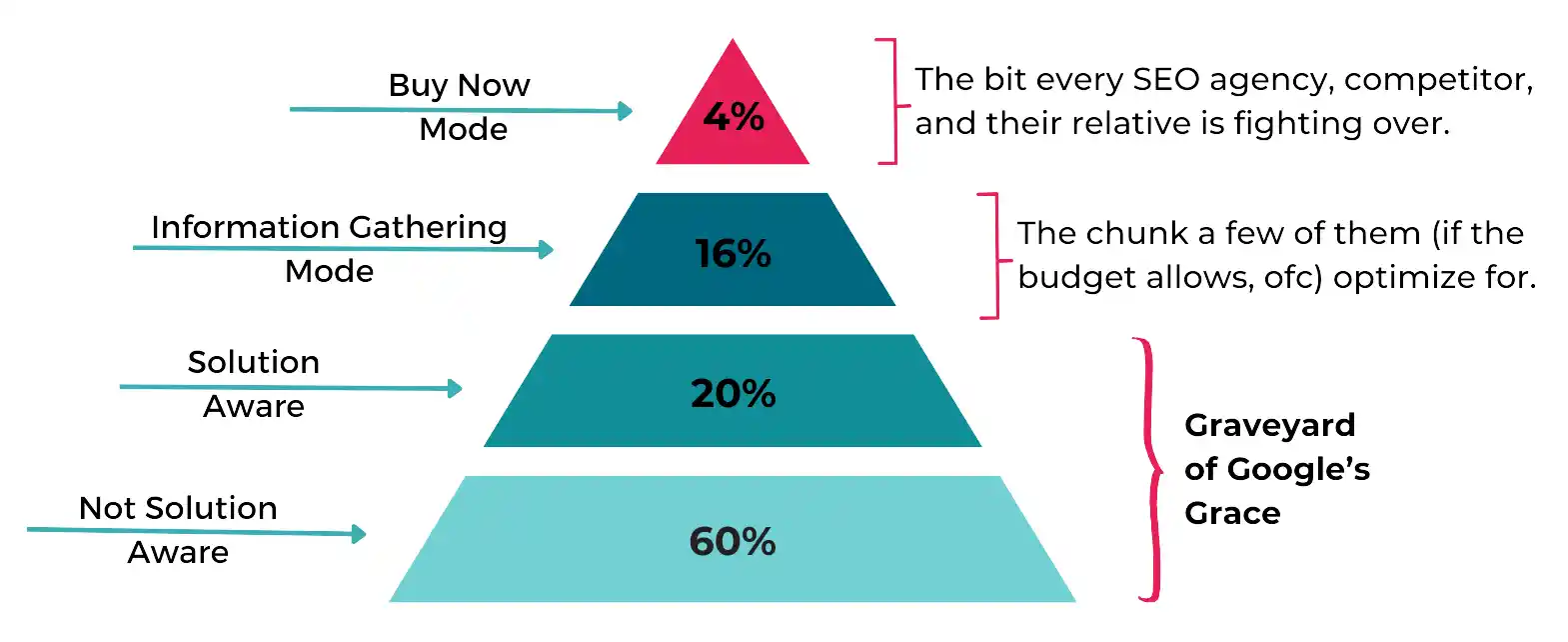
Most SEO strategies focus only on the 4%, targeting keywords like:
- “Best [product] for [use case]”
- “Pricing for [service]”
- “[Competitor] alternatives”
But your best customers—the ones who will spend more, stay longer, and become brand advocates—aren’t searching for you yet. Yeah, let that sink in.
They’re still figuring out their pain points, weighing priorities, or unaware they even have a problem.
And by the time they’re ready to buy, their minds are already made up. They don’t just choose the company that ranks first on Google that day—they choose the brand they’ve been learning from all along.
This is why creating demand and nurturing the 97% is the real growth strategy. Instead of fighting over scraps in the 3%, you build long-term demand by being the brand that educates, informs, and shapes the buying journey before it even begins.
Building a Pipeline to the Promised Land
So, how do you capture and captivate this elusive 97%? By entering the conversation, they are already having at the stage they are at in the customer journey.
But here’s the bummer. The customer journey doesn’t start with “I need to buy X.”
It starts with:
- Awareness – They realize they have a problem (but don’t know the solution).
- Research – They start learning about possible solutions.
- Consideration – They compare different options.
- Decision – They choose a provider and buy.
And that Big Hairy SEO Mistake we began with? Only targeting keywords and creating content for stage 4.
Let’s say you run a consulting firm that helps B2B companies improve their sales process.
A high-intent keyword strategy would focus on terms like:
- “B2B sales consulting services”
- “Best sales consultants for B2B”
That’s great, but it only captures the 3% that is ready to buy today.
Instead, a Narrative -Driven SEO strategy would also address topics like:
- “Why Your B2B Sales Team Is Losing Deals Without Realizing It” (Problem Awareness)
- “5 Signs Your Sales Process Is Outdated & How to Fix It” (Information Gathering)
- “Consulting vs. Sales Training: Which Is Best for Your Business?” (Consideration)
When the reader is ready to buy, they already trust your expertise—so they come to you first.
The result? You dominate demand before competitors even show up.

3 Quick Tips to Get Your Narrative Juices Flowing
Google’s E-E-A-T (Experience, Expertise, Authority, Trust) framework rewards brands that create high-value, expert-driven content.
That means narrative-driven SEO is essential for capturing the 97%. Here is a page from my playbook.
1. Frame the problem before selling the solution.
- Example: “Why Most B2B Buyers Ignore Cold Outreach (And What to Do Instead)”
- Instead of saying, “Our software solves XYZ,” lead with the problem that potential customers are experiencing.
2. Make your audience the hero, not your product.
- Use case studies, real-world examples, and transformation stories.
- Show how businesses like theirs solved problems they didn’t even know they had.
3. Use open loops to keep readers engaged.
- Example: “What’s the biggest mistake B2B companies make when optimizing their sales funnel? You might be surprised.”
- This creates curiosity and encourages deeper content engagement.
The biggest revenue opportunities come from capturing the 97% early, nurturing their interest, and becoming their go-to solution before they even start comparing options.
To implement this in your SEO strategy, you could start with:
✅ Audit your content – Are you only targeting high-intent keywords?
✅ Build an SEO funnel – Map out content for each stage of the buyer’s journey.
✅ Invest in problem-aware content – Start educating, not just selling.
By shifting from SEO that ranks to SEO that builds trust, you’ll generate higher-quality leads, shorten sales cycles, and drive more revenue in the long run.
🚀 Let’s talk about how narrative-driven SEO can grow your revenue. Drop a comment, send me a message, or connect with me here.