

A prospect (now a client) once told me this with a straight face:
“Our previous agency said we need 5 subdomains—one for each country. So we have us.example.com, uk.example.com, in.example.com… But now we are struggling with SEO.”
Of course!
Let me guess. Perhaps you were also told this would “boost international rankings,” “localize experience,” and “scale your global SEO.”
Let me give it to you straight (clears throat):
You don’t expand your authority by fracturing it. You don’t scale visibility by splitting the roof over your own content. And unless you’re Amazon, you don’t need to create five mini-websites to sell in five countries.
This article is a lifeline to help you:
- Avoid common international SEO traps
- Understand when subdirectories, subdomains, or ccTLDs make sense
- Prevent an architecture decision that quietly kills your SEO in multiple regions
Because what you choose has YUGE (as tariff daddy would say), implications for SEO, user experience, and website management.

First, Subdirectory vs. Subdomain—What’s the Difference?
Subdirectory
A subdirectory (also known as a subfolder) is a part of the main domain, treated as an extension of the website, and is formatted as: example.com/subdirectory/
Subdirectories are used to organize content within the same website, and search engines don’t treat them distinctly. Think: one unified house. Every page adds bricks to the same foundation.
- example.com/blog/ for a blog
- example.com/about/ for an about us page
- example.com/support/ for customer support
Subdirectories are useful when:
- You are still small and want to manage SEO under one roof
- You want manageable content and links
- You want to move fast without splitting resources
Subdomain
A subdomain is a small domain that’s part of a larger domain, typically formatted as: subdomain.example.com
Subdomains are often used to create distinct websites with different purposes, and search engines treat them distinctly. Think: separate properties, separate purpose, separate real estate.
- blog.example.com for the blog site
- store.example.com for an e-commerce site
- jp.example.com for geotargeting Japan.
Subdomains are useful when:
- You want different functions (e.g., blog vs landing page)
- You want different audiences (e.g., public vs vendor login)
- You don’t care about shared authority
Alternative Option: Country-Code Top-Level Domains (ccTLDs)
A ccTLD (country-code top-level domain) is a domain that ends with a country-specific suffix like .in, .fr, .de, or .co.uk.
ccTLDs are treated as entirely separate domains by search engines and users.
- example.in for India
- example.fr for France
- example.de for Germany
ccTLDs are useful when:
- You want to target a specific country with high local trust and local SEO advantage
- You are legally required to host or operate in-country (e.g., .ca, .cn, .fr)
- You have regional teams, localized offerings, or pricing for each country
- You’re investing resources in country-specific PR, backlinks, or partnerships
- You’re an enterprise brand treating each country as its strategic market
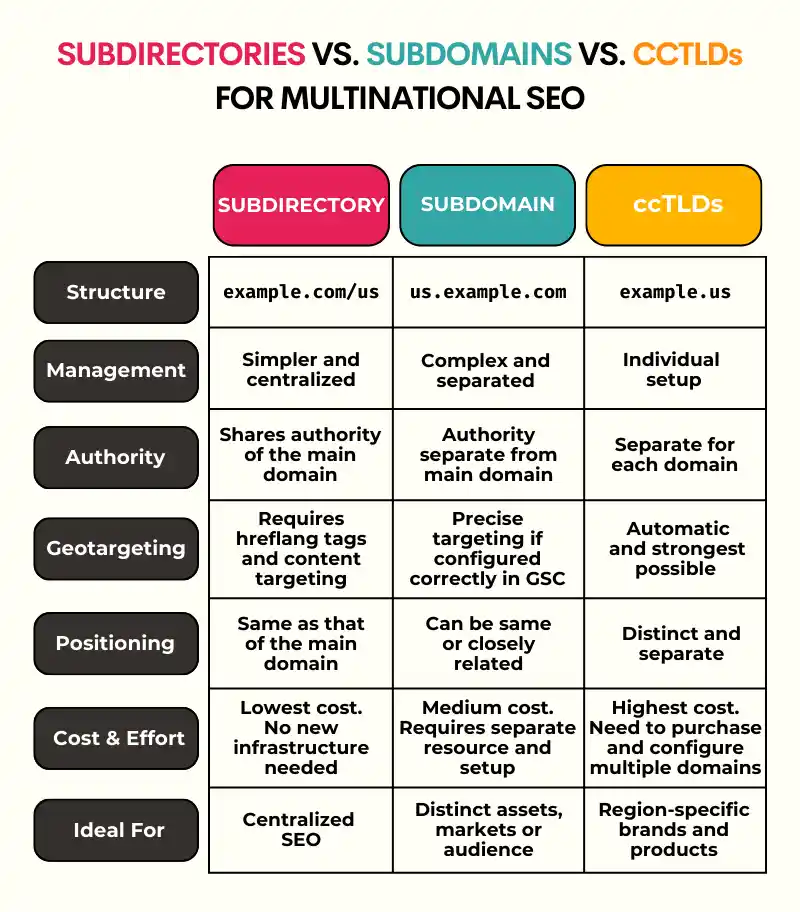
But that’s just the basics. The main question is, WHY SHOULD YOU CARE??
Because when and how you use either can make all the difference for your SEO game. I mean all, especially when you want to target multiple countries.
And if you’re a supplier of solar, semiconductors, electronics, textiles, gems and jewelry, or automobiles, you’re probably feeling the ripple effects of the U.S.–China tariff hikes. But don’t let that force a website split that tanks your traffic.
SEO Trap #354, Called International SEO
There’s a myth that more subdomains = more local visibility.
This is a cash cow for agencies.
They pitch you:
- 1 SEO package per subdomain
- 1 team per market
- 1 content plan per country
That’s not localization. That’s fragmentation.
If you’re pulling in 50K+ monthly traffic and operating in distinct geographies with wildly different messaging, fine—subdomains or even ccTLDs might make sense.
But if your total site traffic is still under 5K and your offer doesn’t shift much across borders? Then, every subdomain is a self-inflicted penalty.
You’re diluting authority, doubling workload, and giving search engines zero indication that this is one cohesive brand.
Here’s how to strategically go about choosing between subdirectories, subdomains, and ccTLDs.
Think of SEO Authority Like Building an Empire
- Every page is a brick.
- Every backlink is mortar.
- Your domain is the castle.
Subdirectories are bricks you stack into one stronghold.
Subdomains are isolated camps you build in separate regions within the same country.
And ccTLDs are castles in different countries—without sharing cultures, materials, or blueprints.
What Agencies Won’t Tell You (But Should)
Most subdomain-first strategies are designed to:
- Lock you into multi-market retainers
- Justify bloated project scopes
- Make you believe complexity = expertise
But let’s be honest—unless your business model or product truly changes by geography, subdomains, and ccTLDs are an expensive distraction.
Until you’ve built real authority and demand in your home market, expanding into “international SEO” is just burning budget for vanity visibility.
Global events like the 2024–2025 tariff hikes are pushing companies to accelerate their international footprint—but that doesn’t mean your website’s structure should follow suit blindly. Before you create that .ae or .com.au version of your site, use this simple 3-question test:
- Do I have at least 10K/mo traffic on my main domain?
- Does my offer, pricing, or content need to change per country?
- Can I afford duplicate content creation and link building per region?
Still unsure? Here’s the rule of thumb:
Subdirectories scale. Subdomains fragment. ccTLDs silo. Pick the one that makes your business simpler—not sexier.
There’s no prize for having uk.example.com if nobody in the UK is searching for you.
And there’s no SEO boost for spending thousands on infrastructure when the real bottleneck is demand.
Unless your main domain reaches a few thousand in traffic, targeting specific countries (other than your primary market) might not be the best strategy. The only exception is when your offer is distinctly different for each geography.
Until then, focus on:
- Consolidating your topical authority
- Driving demand from your core market
- Expanding only when you can translate content and conversion
Anything else is just agencies justifying LTV.
Thinking of international SEO? Let’s review your setup before you invest in 5 new isolated camps with no army.